I used to cry every Sunday night. Not the dramatic kind of crying you see in movies, more like the quiet, exhausted kind where you are sitting on the couch at 9:47 PM staring at the baby monitor and realizing you have to prep six bottles before you can go to bed, and then you have to wake up at 6:15 AM, and then you have to drive across Portland in rush hour traffic with a baby who hates her car seat, and then you have to hand her over to strangers and pretend you are totally fine with it.
Monday mornings were my personal hell. For about three months, I was a disaster. I would forget the nipples. I would send bottles without labels and get a polite but firm note from the daycare director. I would prep five bottles when Lily clearly needed six and get a call at 2 PM asking if I could drop off another one. I would use the wrong formula scoop because I was half-asleep. I would leave the insulated bag on the kitchen counter and only realize it when I was pulling into the daycare parking lot on Powell Boulevard.
And then—this is the part where I tell you about the system, because there IS a system, and it saved me, and it might save you too.
It started with a meltdown. Not Lily's meltdown. Mine. I was standing in the kitchen at 10:30 PM on a Sunday, holding an empty formula can and a bottle brush, and I just... stopped. I put everything down. I walked to the living room. I sat on the floor—literally on the floor, because the couch felt too far away—and I told Mark that I could not do this anymore. Not the parenting part. The logistics part. The part where I was failing at something that seemed so simple for every other mom on Instagram.
Mark, to his credit, did not say "just be more organized." He said, "Let us build a routine." And we did. Over the next two weeks, we tested and refined and argued about bottle prep until we had something that actually worked. Something that meant I could prep all of Monday's bottles in under 20 minutes on Sunday night. Something that meant I never forgot a nipple again. Something that meant I stopped crying on Sunday nights.
Here is what we figured out. Step one: know your numbers. You cannot prep bottles efficiently if you do not know how much your baby eats. For the first two weeks of daycare, I tracked every single feed. Not just at home—I would ask the daycare teachers to text me how much Lily drank at each feeding. I know, I know, I was THAT mom. But I needed the data. I needed to know that on Mondays she tended to eat less because she was adjusting to the new environment, but by Wednesday she was back to her normal 5-6 ounces per feed. I needed to know that she usually wanted a bottle around 10:30 AM, 1:30 PM, and 4:00 PM.
Once I had the numbers, everything else fell into place. I bought a set of six identical bottles—same brand, same size, same everything. I know some people use different bottles for different times of day, but for daycare prep, consistency is your friend. When every bottle is the same, you can prep them on autopilot. No decisions. No hunting for the right nipple flow. Just grab, measure, mix, label, repeat.
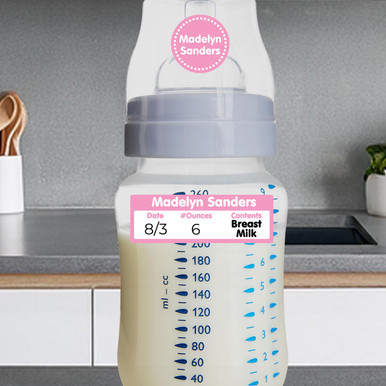
The labeling system was the real game-changer. I started with masking tape and a Sharpie, which worked for approximately three days before the tape fell off in the daycare refrigerator and a teacher had to guess which bottle was Lily's. Then I bought waterproof labels from a craft store on Hawthorne, the kind you can write on with a permanent marker. Better, but still not great. The ink would smudge if the bottle got wet during warming.
What finally worked: a label maker. I know. I felt like a complete nerd buying a label maker specifically for baby bottles. But it produces waterproof, smudge-proof labels that say "LILY HARTWELL - [DATE] - [TIME] - [OUNCES]" and stick to the bottle through washing, warming, and whatever else daycare throws at them. I keep the label maker on the counter next to the formula station. It takes 15 seconds to print a label. Worth every penny of the $24.99 I spent at Office Depot on Burnside.
The prep station itself is key. We cleared one section of the kitchen counter—about two feet of space—and designated it as the bottle zone. Formula can lives there. Scoop lives there. Bottles live there (in a drying rack that doubles as storage). Labels and label maker live there. Insulated bag lives on the hook right next to it. Nothing else goes in that zone. Not mail. Not coffee mugs. Not random toys Lily threw on the counter. That zone is sacred.
Our Sunday night routine goes like this. First, I check the Feeding Log data from the previous week. I look at how many bottles Lily actually consumed each day. I add one extra bottle as a buffer—because daycare always needs a backup, and because sometimes Lily has a growth spurt and wants more than usual. Then I line up all the bottles on the counter. I fill each one with the right amount of filtered water first. Then I add the formula powder, one scoop at a time, leveling each scoop with the back of a knife. Then I put the nipples on, shake each bottle gently, and set them in the refrigerator.
Wait, you might be thinking—does not the formula separate if it sits overnight? Yes. A little. But here is the thing: daycare teachers are professionals. They know to swirl the bottle gently before feeding. And honestly, after sitting in the fridge for 8-12 hours, the formula is actually at the perfect temperature for warming. No waiting for cold water to come to room temperature. No frantic warming at 6 AM. Just grab, label, and go.
The morning routine is even simpler. I grab the prepped bottles from the fridge. I print labels with the date and time. I stick them on each bottle. I put them in the insulated bag with an ice pack. I zip the bag. I put it by the front door. That is it. The whole process takes four minutes. Four minutes. I used to spend forty minutes every morning in a panic, and now I spend four minutes in a calm, repetitive motion that requires zero brain power.
But here is the thing nobody tells you about daycare bottle prep: it is not just about the bottles. It is about the emotional transition. Every bottle you prep is a little piece of your baby's day that you are sending away with them. You are not there for the feeding. You are not there to see if they liked it, if they were fussy, if they drank the whole thing or left an ounce at the bottom. The bottles are your proxy. They represent your care, your attention, your love—packaged in plastic and sent off into someone else's hands.
I used to feel guilty about this. Like I was outsourcing the most intimate part of motherhood. Like the daycare teachers were replacing me at the moments that mattered most. But then I realized something: the bottles I prep with care, the labels I print with precision, the system I built out of desperation—that IS motherhood. It is not about being physically present for every single moment. It is about making sure your baby is fed, and safe, and loved, even when you cannot be there. The bottles are just the mechanism. The love is in the preparation.
Of course, the system breaks down sometimes. Last month, Lily had a stomach bug and did not eat her usual amount for three days. I kept prepping six bottles and she would only drink four. I was throwing away perfectly good formula and feeling terrible about the waste. Then I adjusted—prepped four bottles plus two emergency packs of powder and water in separate containers, so the daycare could mix fresh if needed. Flexibility within the system. That is the key.
Another breakdown: the time I forgot the insulated bag and had to carry the bottles loose in my tote bag. They tipped over. Formula leaked. I arrived at daycare with a bag full of wet bottles and a shirt that smelled like baby formula for the rest of the day. I bought a backup insulated bag that lives in the car now. Redundancy. Another key.
And then there was the week the daycare changed their policy and required all bottles to be labeled with the baby's full name, not just first name. I had to reprint every label. Annoying, but fixable. The system adapts. That is what systems do.
Here is what I would tell any parent starting daycare for the first time: build your system before you need it. Do not wait for the Sunday night meltdown. Set up the prep station before the first day. Track the feeds before the first week. Buy the label maker before the first note from the director. The emotional transition is hard enough without the logistical chaos.
And give yourself grace. The first week will be messy. The second week will be slightly less messy. By the third week, you will have a rhythm. By the fourth week, you will prep bottles on autopilot while listening to a podcast and drinking coffee. It gets easier. I swear to you, it gets easier.
I do not cry on Sunday nights anymore. I prep bottles, I set the alarm, I go to bed. And on Monday morning, I hand Lily over to her teachers with six perfectly labeled bottles in an insulated bag, and I drive to work knowing she is going to be fed exactly what she needs, exactly when she needs it. The system works. The love gets there. That is enough.
— Emily Hartwell, from Portland with a label maker and a little more sleep
