38 ounces. In one day. My eight-month-old daughter drank 38 ounces of formula in a single 24-hour period, and I sat on the kitchen floor at 11:47 PM holding the empty bottles and wondering if I had somehow broken the laws of physics. Or biology. Or both.
It was a Tuesday. I remember because Tuesdays are my clinic days at the pediatric nutrition center, which means I am already exhausted from seeing 12 families before noon, and I came home to find Mark looking shell-shocked on the couch. "She has eaten four bottles since you left," he said. "And she is reaching for a fifth."
I did the math. Four bottles, six ounces each, plus the two she had had before I left for work, plus the one she had demanded at 3 AM, plus the one she had chugged at 6:30 PM. 38 ounces. For a baby who usually topped out at 26. For a baby whose weight was sitting comfortably at the 50th percentile. For a baby who, as far as I knew, was not secretly training for a baby Olympics.
I called my mother. I know, I know. Calling your mother at 11:47 PM is a rookie move. But I was a registered dietitian who had spent three years in the NICU calculating precise feeding volumes for premature infants, and I was sitting on my kitchen floor genuinely questioning whether my own child had a tapeworm. My mother, bless her, said: "She is growing. They do that."
She was right. Of course she was right. Growth spurts are one of those things that every parenting book mentions in passing—"your baby may want to feed more frequently during growth spurts"—but nobody actually explains what that FEELS like. It feels like your baby has been replaced by a tiny vacuum cleaner. It feels like you are mixing formula every 45 minutes. It feels like your grocery budget just exploded. It feels like you are failing because clearly no baby should need this much food, except they do, and it is normal, and you just have to survive it.
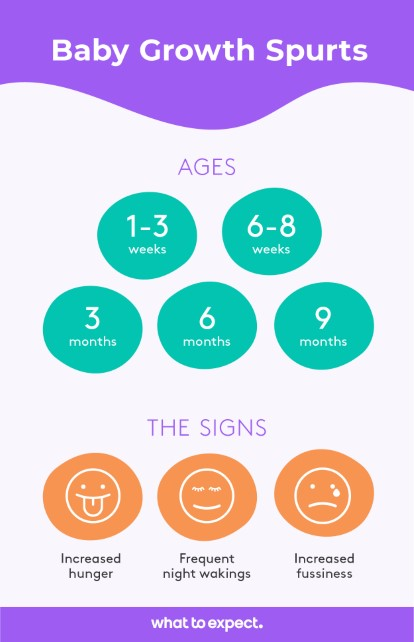
Here is what I know about growth spurts, from both clinical practice and personal trauma. They happen at predictable intervals: around 2-3 weeks, 6 weeks, 3 months, 6 months, and 9 months. But "predictable" is a loose term. Some babies hit them early. Some hit them late. Some have mini-spurts that last a day, and some have marathon spurts that last a week and make you question your sanity. Lily's 38-ounce day happened at 8 months, which is technically "late" for a major spurt, but babies do not read the textbooks.
The signs are always the same, even if the timing varies. Increased hunger. More frequent feeding requests. Fussiness between feeds that is not colic—it is just hunger. Longer naps (because growing is exhausting). And sometimes, weirdly, shorter naps (because hunger wakes them up). It is like your baby's body sends a memo to their stomach that says "we are building a lot of cells right now, please send more supplies," and the stomach responds by turning into a bottomless pit.
As a dietitian, I can tell you the science. Growth hormone pulses increase during sleep, which is why babies often want to feed more before and after naps. The brain is developing rapidly, which requires glucose and lipids in quantities that would make an adult diabetic. The bones are lengthening. The muscles are strengthening. The immune system is building its arsenal. Every system in that tiny body is running at maximum capacity, and fuel is the limiting factor.
As a mom, I can tell you the reality. You will run out of formula. You will make emergency runs to Fred Meyer at 9 PM. You will stand in the formula aisle staring at the cans and doing mental math about how many you need to get through the week. You will consider buying the bulk warehouse size. You will wonder if you should just set up a subscription delivery. You will Google "can a baby drink too much formula" at 2 AM. (The answer is: not really, but you should still check with your pediatrician if intake exceeds 32 ounces regularly for an infant under 6 months.)
The first growth spurt that caught me off guard was at 3 weeks. Lily was a preemie, born at 36 weeks, so she was already small and I was already paranoid about her weight gain. She had been taking 2-3 ounces every 3 hours, which is exactly what the NICU discharge instructions said. Then one morning, she finished a 3-ounce bottle and started rooting around like she was still starving. I made another 2 ounces. She drank it. I made another 2 ounces. She drank that too. 7 ounces at 3 weeks old. I called the pediatrician's office in a panic.
The nurse laughed. Not in a mean way. In a "honey, this is completely normal" way. "She is growing," the nurse said. "Offer her what she wants. She will stop when she is full."
And she did. After 7 ounces, Lily fell asleep for four hours—the longest stretch she had ever slept. She woke up hungry again, but not INSATIABLY hungry. The spurt had peaked. Over the next two days, her intake gradually returned to normal. And when I weighed her at her next appointment, she had gained almost a pound in a week. A POUND. In a WEEK. That is what 7-ounce bottles will do.
By the time the 6-week spurt hit, I was ready. I had stocked up on formula. I had prepared Mark for the chaos. I had told myself that this was temporary, that it would pass, that I just needed to keep up with demand for a few days. And it was fine. Stressful, expensive, and exhausting, but fine. The 3-month spurt was bigger—Lily went from 24 ounces to 32 ounces for almost a week—but I had a system by then. I tracked everything in the Feeding Log. I adjusted the Formula Calculator daily. I watched the Growth Chart curve jump upward and felt, for the first time, like I was actually witnessing my baby grow in real time.
But the 8-month spurt? The 38-ounce day? That one got me. Because by 8 months, you are supposed to be in a rhythm. The baby is eating solids. The formula intake is supposed to be decreasing, not increasing. You are supposed to be transitioning toward sippy cups and finger foods and all the milestones that mean "my baby is growing up." Instead, Lily looked at her pureed carrots, pushed them away, and pointed at her bottle with the intensity of someone who had just discovered their life's purpose.
I spent that week in a haze of formula mixing. I would prep a batch of bottles, thinking they would last the afternoon, and they would be gone by 2 PM. I would mix more, thinking they would last until bedtime, and Lily would demand one at 7 PM, 8 PM, and 9 PM. Mark started calling her "the tank." I started calculating our formula budget in weekly instead of monthly increments. I seriously considered buying a second refrigerator just for formula storage.
And then, on day six, she woke up and drank her usual 5 ounces. No drama. No reaching for the bottle. No screaming between feeds. Just... normal. I checked the Feeding Log. 26 ounces for the day. Back to baseline. The spurt was over. She had grown. I could breathe again.
Here is what I learned, and what I tell every parent who messages me in a panic about their suddenly insatiable baby: growth spurts are not a problem to solve. They are a phase to survive. Your baby is not broken. Your formula is not inadequate. Your parenting is not failing. Your baby is just... growing. Building bones. Building brain cells. Building the body they will live in for the next eighty years. And that building process requires materials.
The practical advice is simple but hard to execute when you are exhausted. Stock up before known spurt windows. Track intake so you can see the pattern. Do not restrict feeds—babies self-regulate better than any calculator. Do not switch formulas unless there is a medical reason. Do check in with your pediatrician if the spurt lasts more than a week or if intake exceeds safe limits. And do remember that this, like everything else in parenting, is temporary.
Lily is two now. She does not drink formula anymore. She drinks whole milk from a sippy cup, usually while running around the living room and dropping crackers on the floor. I look at her sometimes—really look at her—and I am amazed by how much she has grown. From 5 pounds at birth to almost 30 pounds at two years. From preemie clothes to 2T. From 2-ounce bottles to actual sandwiches. All those growth spurts, all those extra ounces, all those emergency formula runs—they built this person. They built her bones and her brain and her immune system and her personality.
38 ounces in one day. I still cannot quite believe it. But I believe in the growth it produced. And I believe that every parent currently in the middle of a growth spurt will survive it, even if it does not feel that way at 11:47 PM with an empty formula can and a baby who wants just one more bottle.
— Emily Hartwell, from Portland with a very tall toddler and a very empty wallet
